A Sustainable AI-Oriented Framework for Energy-Efficient Data Processing in Next-Generation Edge–Cloud Ecosystems
Keywords:
Sustainable Artificial Intelligence, Edge–Cloud Computing, Energy-Efficient Data Processing, Edge Intelligence, Federated AI, Green Computing, Reinforcement LearningAbstract
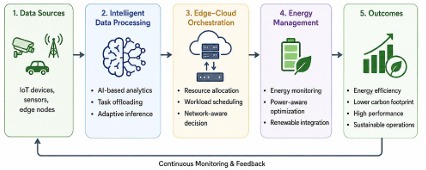
The rapid growth of artificial intelligence (AI), Internet of Things (IoT), edge computing, and cloud-native infrastructures has significantly increased the demand for scalable, energy-efficient, and sustainable data processing architectures capable of supporting next-generation intelligent ecosystems. Modern edge–cloud environments continuously generate massive volumes of heterogeneous data from autonomous systems, smart cities, industrial automation platforms, healthcare infrastructures, intelligent transportation systems, and real-time surveillance networks. Traditional cloud-centric architectures frequently suffer from latency bottlenecks, excessive communication overhead, inefficient resource allocation, and unsustainable energy utilization under large-scale real-time operational workloads. This research proposes a Sustainable AI-Oriented Framework for Energy-Efficient Data Processing in Next-Generation Edge–Cloud Ecosystems designed to optimize intelligent resource allocation, adaptive workload scheduling, energy-aware processing coordination, sustainable AI inference, and low-latency distributed analytics across heterogeneous edge–cloud infrastructures. The proposed framework integrates edge intelligence, federated AI coordination, adaptive workload orchestration, deep reinforcement learning-based optimization, graph-driven resource analytics, and explainable energy-aware decision support to improve sustainable distributed computing performance while minimizing computational overhead and energy consumption. The framework dynamically performs intelligent workload partitioning, adaptive edge–cloud task migration, energy-aware resource scheduling, AI-assisted infrastructure optimization, and low-power distributed processing coordination using contextual environmental analytics and reinforcement-driven optimization mechanisms.
Sustainable Artificial Intelligence, Edge–Cloud Computing, Energy-Efficient Data Processing, Edge Intelligence, Federated AI, Green Computing, Reinforcement Learning.