Secure Federated Learning Framework Against Adversarial Attacks in Decentralized Edge Intelligence Systems
Keywords:
Federated Learning, Adversarial Attack Detection, Edge Intelligence Systems, Secure Aggregation, Blockchain Security, Graph Neural NetworksAbstract
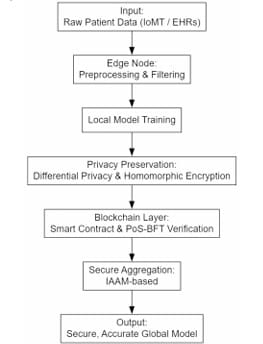
The rapid growth of distributed edge intelligence systems, Internet of Things (IoT) ecosystems, autonomous cyber-physical infrastructures, healthcare monitoring networks, industrial automation platforms, and smart communication environments has significantly increased the demand for privacy-preserving collaborative artificial intelligence frameworks. Federated Learning (FL) has emerged as a transformative distributed machine learning paradigm that enables multiple edge devices and decentralized infrastructures to collaboratively train intelligent models without directly sharing sensitive local data. By preserving data locality and minimizing centralized data exposure, federated learning significantly improves privacy preservation and distributed intelligence coordination across heterogeneous edge environments. However, despite these advantages, federated learning systems remain highly vulnerable to adversarial cyber-attacks including data poisoning, model poisoning, Byzantine attacks, gradient manipulation, backdoor insertion, inference attacks, and malicious client coordination. These attacks severely compromise model integrity, distributed trust coordination, and adaptive decision-making reliability within decentralized edge intelligence ecosystems. This research proposes a Secure Federated Learning Framework Against Adversarial Attacks in Decentralized Edge Intelligence Systems. The proposed framework integrates blockchain-assisted distributed trust coordination, graph neural adversarial reasoning, transformer-based anomaly analytics, adaptive secure aggregation, reinforcement-driven cyber optimization.