A Systematic Review of Inverse Modelling Techniques for Medical Image Reconstruction Problems: Methods, Architectures, and Future Research Directions
Keywords:
Inverse Modelling, Medical Image Reconstruction, Deep Learning, Physics-Informed Neural Networks, Ill-posed Problems, Sparse ReconstructionAbstract
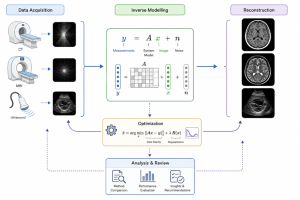
Inverse modelling techniques have emerged as a fundamental paradigm in medical image reconstruction, enabling the recovery of high-quality images from incomplete, noisy, or indirect measurements. These techniques are central to modalities such as computed tomography (CT), magnetic resonance imaging (MRI), positron emission tomography (PET), and ultrasound imaging, where forward models are well-defined but inverse solutions are often ill-posed. This paper presents a comprehensive systematic review of inverse modelling approaches developed between 2018 and 2025, focusing on classical optimization-based frameworks, model-driven deep learning architectures, and hybrid physics-informed neural networks. The review highlights advancements in regularization strategies, sparsity-driven reconstruction, variational inference, and generative models such as GANs and diffusion models. Key findings indicate a significant shift from purely analytical inverse solvers toward data-driven and physics-informed hybrid architectures that improve reconstruction fidelity and computational efficiency. The paper also identifies critical challenges including generalization, interpretability, data scarcity, and robustness to domain shifts. The contributions of this work include a structured synthesis of recent literature, a comparative evaluation of methodologies, and the identification of future research directions for integrating inverse modelling within modern software engineering and AI-driven healthcare systems.