A Systematic Review of Mathematical Modelling of Ventilation–Perfusion Mismatch in Lung Function: Methods, Architectures, and Future Research Directions
Keywords:
Ventilation–Perfusion Mismatch, Mathematical Modelling, Lung Function, Computational Physiology, Gas Exchange ModelsAbstract
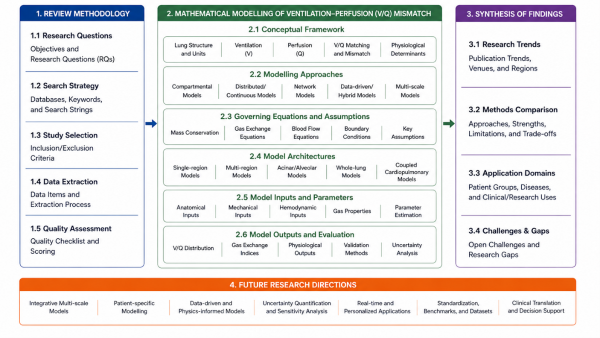
Ventilation–perfusion (V/Q) mismatch is a fundamental physiological disorder underlying various respiratory diseases, including acute respiratory distress syndrome (ARDS), chronic obstructive pulmonary disease (COPD), and pulmonary embolism. Mathematical modelling of V/Q mismatch has emerged as a critical tool for understanding lung physiology, predicting disease progression, and optimizing therapeutic interventions. This systematic review examines recent advances (2018–2023) in mathematical modelling approaches for ventilation–perfusion mismatch, focusing on modelling techniques, computational architectures, and clinical applications. The review explores classical compartmental models, computational physiological models, and data-driven hybrid frameworks integrating machine learning and physics-based modelling. Special emphasis is placed on models such as multiple inert gas elimination technique (MIGET), alveolar gas exchange models, and patient-specific computational lung simulations. Furthermore, the study highlights the integration of imaging techniques such as electrical impedance tomography (EIT) and CT-based modelling for real-time assessment of V/Q mismatch. The analysis reveals that while traditional models provide physiological interpretability, modern hybrid models improve predictive accuracy and personalization. However, challenges remain in model validation, computational complexity, and clinical translation. Future research directions include digital twin frameworks, AI-assisted modelling, and real-time bedside monitoring systems. This review provides a comprehensive foundation for developing next-generation intelligent respiratory modelling systems.