Deep Learning-Based Predictive Models for Early Disease Diagnosis and Prognosis in Healthcare Systems
Keywords:
Deep Learning, Disease Diagnosis, Prognosis Prediction, Healthcare Analytics, Convolutional Neural Networks, LSTM NetworksAbstract
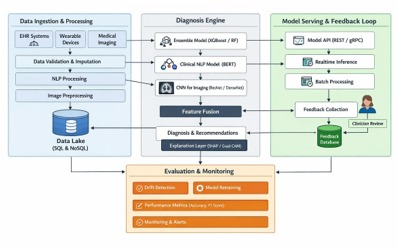
Deep learning has emerged as a transformative technology in modern healthcare systems by enabling intelligent analysis of complex biomedical data for disease diagnosis, prognosis prediction, and clinical decision support. The increasing availability of electronic health records (EHRs), medical imaging datasets, genomic information, wearable sensor data, and real-time patient monitoring systems has created unprecedented opportunities for data-driven healthcare analytics. Traditional machine learning and statistical diagnostic methods often struggle to capture nonlinear relationships and hidden patterns within high-dimensional medical datasets. Consequently, deep learning architectures such as convolutional neural networks (CNNs), recurrent neural networks (RNNs), long short-term memory (LSTM) networks, transformers, and hybrid neural models have become increasingly important for early disease detection and predictive healthcare analytics. This research proposes a Deep Learning-Based Predictive Framework for Early Disease Diagnosis and Prognosis in Healthcare Systems. The proposed framework integrates multimodal medical data processing, deep neural feature extraction, predictive learning, and intelligent prognosis modeling to improve diagnostic accuracy and early disease prediction capability. The framework combines CNN-based medical image analysis, LSTM-driven temporal health monitoring, attention mechanisms, and hybrid predictive learning strategies to support intelligent clinical decision-making across diverse healthcare applications. The proposed system supports early diagnosis and prognosis prediction for diseases including cancer, cardiovascular disorders, diabetes, neurological diseases, and infectious conditions. Experimental evaluation demonstrates that deep learning-based predictive models significantly improve diagnostic sensitivity, specificity, prediction accuracy, and early disease detection performance compared to traditional machine learning approaches. The framework also enhances healthcare scalability, real-time monitoring capability, and personalized treatment planning while reducing diagnostic delay and human error.