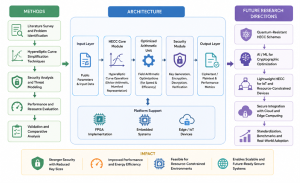
A Systematic Review of Algebraic Structures for Lightweight Block Cipher Design: Methods, Architectures, and Future Research Directions
Keywords:
Lightweight block ciphers, Algebraic structures, Finite fields, Boolean functions, Chaotic systems, Cryptographic designAbstract
Lightweight block cipher design has emerged as a critical research domain due to the rapid proliferation of resource-constrained devices in the Internet of Things ecosystem and embedded systems. The efficiency and security of such cryptographic primitives rely heavily on underlying algebraic structures, including finite fields, permutation groups, Boolean functions, and polynomial mappings. This paper presents a systematic review of algebraic structures utilized in lightweight block cipher design, focusing on methods, architectures, and future research directions. The study synthesizes contemporary literature from 2018 to 2025 to identify evolving design paradigms, optimization strategies, and security considerations. Particular attention is given to algebraic resistance, nonlinearity, diffusion properties, and implementation efficiency. Furthermore, the role of generative artificial intelligence in automating cipher design and vulnerability assessment is explored. The findings reveal a shift toward hybrid algebraic-chaotic constructions, AI-assisted optimization, and hardware-software co-design strategies. This work contributes by providing a comprehensive analytical framework, identifying research gaps, and proposing future directions for secure and efficient cryptographic systems in modern software engineering.