A Systematic Review of Cryptographic Path Hardening in Multi-Tenant Web Platforms: Methods, Architectures, and Future Research Directions
Keywords:
Cryptographic path hardening, Multi-tenant web platforms, Cloud security, Secure enclaves, Zero Trust Architecture, Blockchain securityAbstract
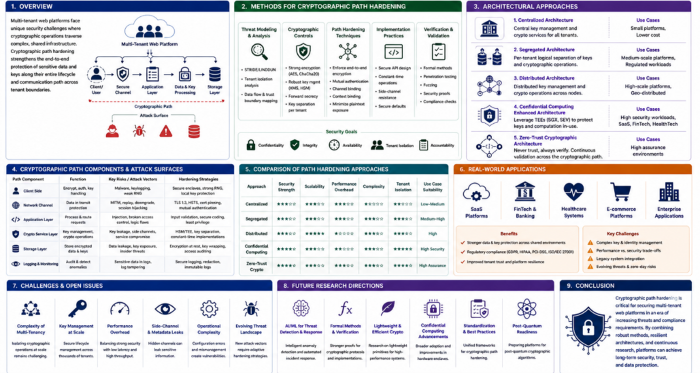
The rapid evolution of multi-tenant web platforms, particularly in cloud computing and software-as-a-service (SaaS) environments, has introduced significant security challenges related to data isolation, access control, and vulnerability exploitation. In such environments, multiple tenants share underlying infrastructure, increasing the risk of cross-tenant attacks and information leakage. Cryptographic path hardening has emerged as a promising approach to mitigate these risks by embedding cryptographic mechanisms into execution paths, thereby preventing attackers from exploiting software vulnerabilities or analyzing system behavior. This paper presents a systematic review of cryptographic path hardening techniques in multi-tenant web platforms, focusing on security models, architectural designs, and optimization strategies. The review analyzes research, covering topics such as secure enclaves, Zero Trust architectures, blockchain-based isolation, and post-quantum cryptographic techniques. It highlights how cryptographic path hardening enhances security by obfuscating execution logic, protecting sensitive computations, and enforcing strict tenant isolation. The findings indicate that integrating cryptographic techniques with system-level security mechanisms significantly improves resilience against attacks such as side-channel exploitation, privilege escalation, and cross-tenant data leakage. However, challenges remain in terms of performance overhead, scalability, and integration with legacy systems. The paper concludes by identifying future research directions, including AI-driven security models, hardware-assisted cryptography, and quantum-resistant architectures.