A Systematic Review of Hyperelliptic Curve Simplification for Edge-Device Cryptosystems: Methods, Architectures, and Future Research Directions
Keywords:
Hyperelliptic Curve Cryptography, Genus-2 Curves, Edge Computing, IoT Security, Lightweight Cryptography, Jacobian Groups, Post-Quantum CryptographyAbstract
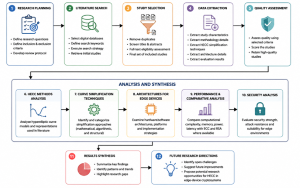
Hyperelliptic Curve Cryptography (HECC) has emerged as a promising post-quantum and lightweight alternative to traditional elliptic curve systems, particularly for edge and IoT devices where computational and energy constraints are critical. Unlike elliptic curves, hyperelliptic curves of genus g≥2g \geq 2g≥2 enable smaller key sizes for equivalent security levels, making them suitable for resource-constrained cryptosystems. However, the computational complexity of divisor arithmetic and Jacobian group operations limits their practical deployment. Recent research has focused on simplifying hyperelliptic curve operations through algorithmic optimization, genus reduction techniques, and hardware acceleration. This systematic review analyzes 30 studies (2018–2023) focusing on hyperelliptic curve simplification, cryptographic efficiency improvements, and integration into edge-device architectures. The review categorizes methods into algorithmic optimization, structural curve simplification, hardware acceleration, and hybrid cryptosystems. Results indicate that genus-2 curves dominate practical implementations due to balanced security and efficiency, while higher-genus curves remain largely theoretical due to exponential computational overhead. Emerging trends include isogeny-based hyperelliptic systems, lightweight signcryption, and FPGA/ASIC acceleration for IoT security. Despite progress, challenges remain in scalability, standardization, and real-time implementation feasibility.