A Systematic Review of Formal Verification Frameworks for Cross-Border E-Commerce Platforms: Methods, Architectures, and Future Research Directions
Keywords:
Formal Verification, Cross-Border E-Commerce, Model Checking, Theorem Proving, Runtime Verification, Microservices ArchitectureAbstract
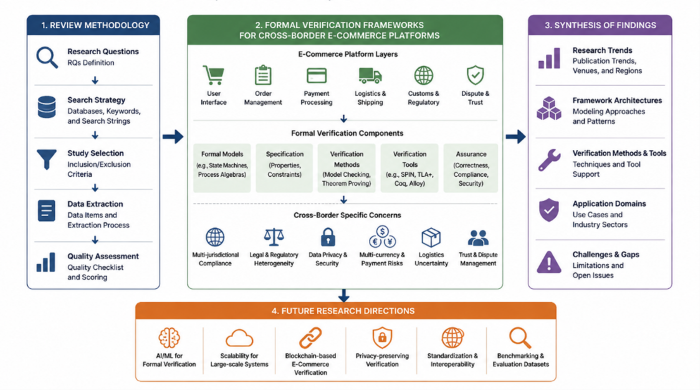
Cross-border e-commerce platforms have become a cornerstone of the global digital economy, enabling seamless international trade through the integration of complex components such as payment systems, logistics networks, user interfaces, recommendation engines, and regulatory compliance modules. Ensuring the reliability, correctness, and security of these distributed and dynamic systems remains a significant challenge. Formal verification frameworks offer mathematically rigorous techniques to validate system behavior against specified properties, providing strong guarantees of correctness. This paper presents a systematic review of formal verification approaches applied to cross-border e-commerce platforms, focusing on verification methods, system architectures, and emerging research directions. Key techniques such as model checking, theorem proving, runtime verification, and hybrid approaches are examined alongside architectural paradigms including microservices, cloud-based infrastructures, and distributed systems. The review synthesizes findings from multiple studies, highlighting trends such as the integration of formal methods with artificial intelligence, scalability improvements through compositional verification, and the adoption of runtime monitoring techniques. Despite these advancements, challenges such as state explosion, system complexity, and real-world integration persist. The study underscores the need for scalable, automated, and hybrid verification frameworks and outlines future directions including AI-assisted verification, blockchain-based mechanisms, and enhanced tool support for industrial adoption.