A Systematic Review of Threshold Secret Sharing with Dynamic Weighted Access Structures: Methods, Architectures, and Future Research Directions
Keywords:
Threshold Secret Sharing, Dynamic Access Structures, Weighted Secret Sharing, Cryptography, Secure Multiparty Computation, Blockchain SecurityAbstract
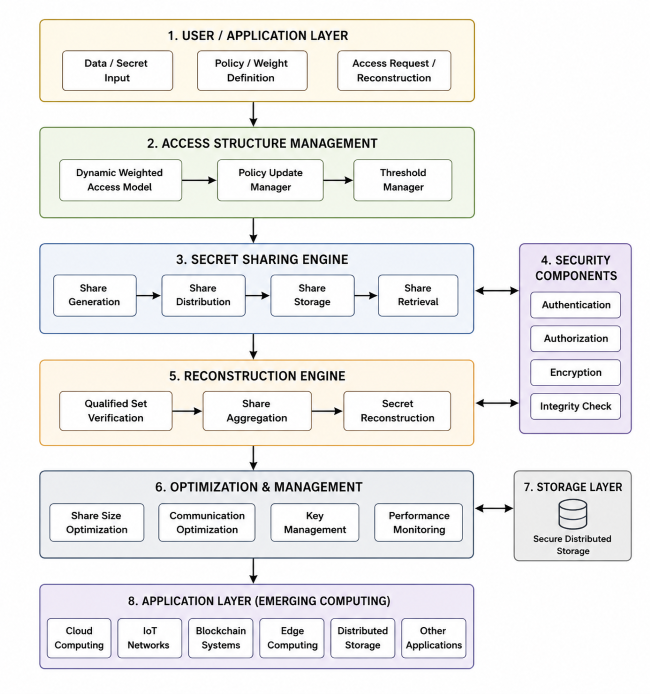
Threshold Secret Sharing (TSS) has emerged as a fundamental cryptographic primitive for secure data distribution, enabling a secret to be divided among multiple participants such that only authorized subsets can reconstruct it. Recent advancements extend classical TSS into dynamic weighted access structures, where participants possess varying levels of authority and system parameters evolve over time. These developments are particularly relevant in modern distributed systems such as cloud computing, blockchain, and secure multiparty computation. This paper presents a systematic review of topology-driven and structure-aware TSS models, focusing on dynamic thresholds, weighted participant roles, and adaptive access control mechanisms. Traditional schemes such as Shamir’s threshold model are limited by static configurations, whereas contemporary approaches introduce hierarchical, compartmented, and evolving access structures that improve flexibility and security. The review analyses recent methods including lattice-based TSS for post-quantum security, blockchain-integrated secret sharing, and dynamic evolving schemes that adjust thresholds according to system changes. Additionally, weighted threshold schemes assign importance to participants, allowing more realistic modeling of organizational hierarchies and distributed trust environments. Key findings indicate a transition from static threshold systems to adaptive, scalable, and robust architectures capable of resisting adversarial attacks and supporting real-time applications. However, challenges remain in terms of computational complexity, scalability, and efficient implementation of dynamic access policies. This study contributes by synthesizing recent advancements (2018–2023), identifying research gaps, and proposing future directions such as lightweight dynamic schemes, AI-integrated access optimization, and quantum-resistant secret sharing models.