A Comprehensive Review of Graph Neural Networks for Adversarial Example Detection: Architectures, Robustness, and Intelligent Security Applications
Keywords:
Graph Neural Networks (GNNs), Adversarial Examples, Adversarial Detection, Cybersecurity, Deep Learning RobustnessAbstract
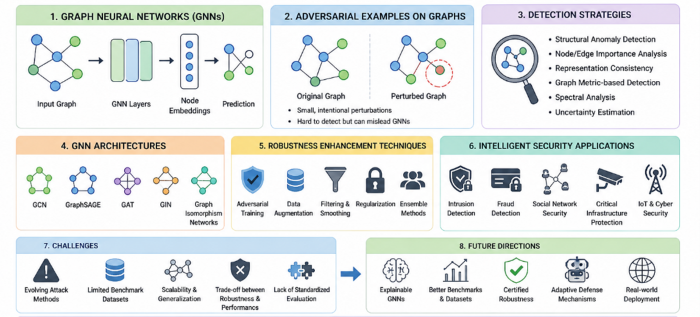
Graph Neural Networks (GNNs) have emerged as a powerful paradigm for modeling structured and relational data across various domains such as cybersecurity, social networks, and intelligent systems. However, like traditional deep learning models, GNNs are vulnerable to adversarial examples—carefully crafted perturbations that mislead model predictions while remaining imperceptible. This vulnerability raises serious concerns regarding the deployment of GNNs in security-critical applications such as intrusion detection systems, fraud detection, and autonomous systems. In recent years, significant research efforts have been directed toward leveraging GNNs not only as vulnerable models but also as robust frameworks for detecting adversarial examples. This paper presents a comprehensive review of GNN-based adversarial example detection approaches, focusing on architectural innovations, robustness mechanisms, and intelligent security applications. We systematically analyze studies published between 2018 and 2023, highlighting the evolution of detection techniques including graph-guided testing, adversarial edge detection, graph immunization strategies, and robust architecture search. Additionally, we explore how graph structures enable better representation of relationships among data points, thereby improving the detection of anomalous and adversarial patterns. The review further examines key challenges such as scalability, transferability of attacks, and lack of theoretical robustness guarantees. Emerging trends including hybrid models, explainable GNNs, and graph-based defense mechanisms are also discussed. A comparative analysis of selected studies provides insights into performance metrics, datasets, and detection strategies. Overall, this work aims to provide researchers and practitioners with a structured understanding of GNN-based adversarial detection methods and identify future research directions for building secure and trustworthy AI systems.